✅ Expert reviewed
This article has been reviewed by Moraya Seeger DeGeare, licensed marriage and family therapist, to ensure the guidance on relationship red flags is clinically sound and trauma‑informed.
What is a red flag in a relationship?
On the road, red means stop, yellow means slow down, and green means go. In relationships, the “traffic light” metaphor still applies — but the signals are far less clear.
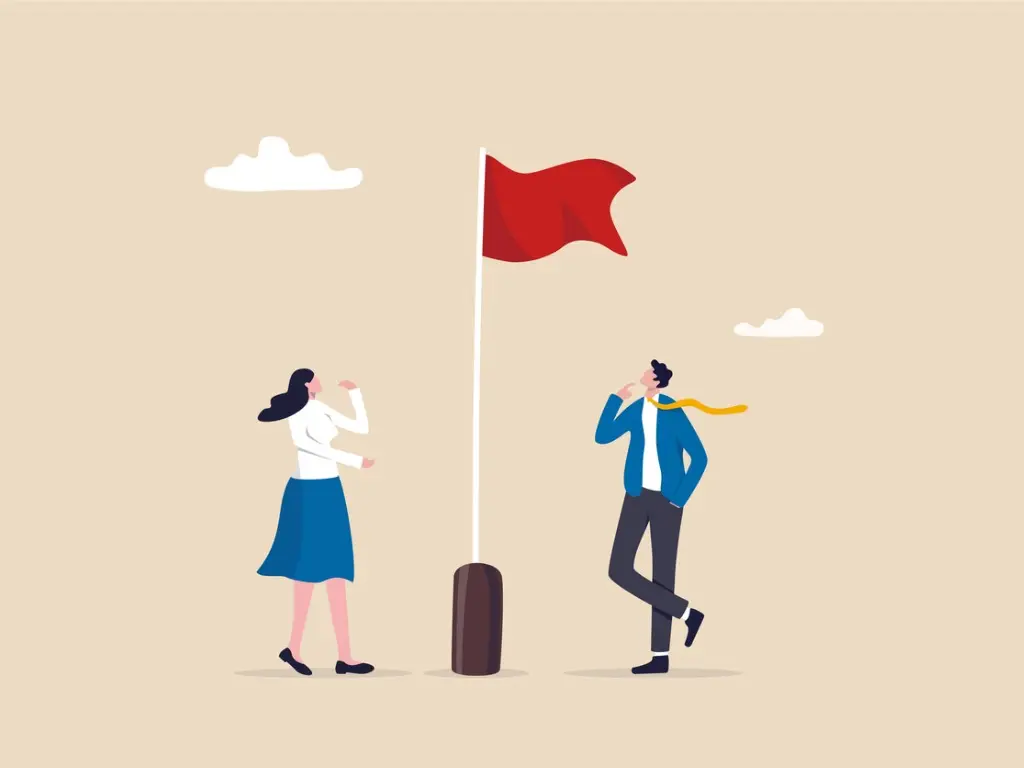
Red flags are warning signs or patterns that suggest something is seriously off in a romantic relationship.
One isolated red flag may not end a relationship, but if the same warning signs keep appearing, it is important to pay attention.
Red flags tend to show up in unhealthy or toxic dynamics, and learning to recognise them early can protect your emotional, and sometimes physical, wellbeing.
Before getting serious with someone, it helps to be honest with yourself about your personal dealbreakers. Knowing what you will and will not accept makes it easier to walk away from behaviour that crosses your boundaries.
Unfortunately, when we are wearing rose‑tinted glasses, it is easy to wave away red flags — especially if we are scared of being alone or very invested in the fantasy of the relationship.
Ignoring those early signs might preserve the connection in the short term, but in the long term it often leads to more hurt.
1. Love bombing
Most of us love the idea of a fairytale romance — falling head‑over‑heels fast and feeling “chosen.”
Love bombing takes that fantasy and turns it into a manipulation tactic. A partner showers you with intense affection, constant messages, and big promises far too early on.
“Are you in love with the story you are telling yourself about what the relationship is? Or are you truly feeling deeply connected to this person?” asks Seeger DeGeare.
Research suggests love bombing is common among people with narcissistic traits: they use extreme affection to create co‑dependency and a sense of control, then withdraw that love to keep you off‑balance.
2. Lack of communication and chronic dishonesty
Not everyone is naturally great at communication, but a consistent refusal to talk honestly is a serious red flag.
If your partner lies, hides key parts of their life, or becomes defensive any time you ask reasonable questions, trust quickly crumbles.
Tactics like silent treatment or dismissing you with lines such as “You are too emotional” or “You would not understand” can also be abusive when used to cause distress or shut down your perspective.
3. Controlling behaviour and extreme jealousy
It is easy to mistake controlling behaviour for protectiveness, especially early on when attention can feel flattering.
Possessiveness, constant jealousy, or insisting on knowing where you are at all times usually points to deep trust issues.
Control can show up as telling you what to wear, checking your messages, isolating you from friends and family, or gaslighting you into doubting your own judgement.
Even if these behaviours start small, they often escalate. Research links controlling partners with a higher risk of later physical abuse, so it is crucial to take these signs seriously.
4. No healthy relationships in their life
How someone talks about their exes, friends, and family can tell you a lot.
If your date constantly calls their exes “crazy” or “toxic,” but never acknowledges their own part in past relationship breakdowns, that is a red flag.
A pattern of having no stable friendships or family connections may also hint at difficulty with forming and maintaining healthy bonds.
5. Extreme emotional reactions
Everyone is allowed to have big feelings, especially in stressful moments.
But if your partner’s reactions are consistently far out of proportion to the situation — and you feel like you are walking on eggshells to avoid setting them off — this can be a sign of emotional abuse.
“Intimate relationships often activate a lot of intense emotions,” says Seeger DeGeare. “What is vital is that the behaviour is acknowledged, interpreted, and each person owns working on that behaviour.”
6. Financial secrecy or infidelity
Money and trust are closely linked. Hiding debts, secret accounts, or large purchases from a partner is a form of financial infidelity.
If your partner repeatedly crosses agreed‑upon financial boundaries or lies about spending — particularly on things like porn, sex work, or other relationships — it can be deeply destabilising.
Repeated secrecy here is a strong sign to pause and reassess.
7. Gaslighting and manipulation
Gaslighting is a tactic where someone makes you doubt your own reality — telling you that events did not happen, that you are “too sensitive,” or that you are “crazy” for reacting.
Over time, gaslighting can severely erode your self‑confidence and sense of autonomy.
If you regularly feel confused about what is real, apologise even when you are not sure you have done anything wrong, or feel like you cannot trust your own memory, take this seriously.
8. Any form of abuse
Abuse is never acceptable — whether physical, sexual, emotional, or psychological.
Repeated insults, threats, intimidation, coercion, or physical harm are not “just part of passion” or “normal couple fights.”
If you suspect you are in an abusive relationship, your safety comes first. Reach out to trusted people and professional organisations for support, and consider making a safety plan to leave.
9. Lack of empathy
Partners will not always respond perfectly in a crisis, but a chronic lack of empathy is worrying.
If your partner regularly dismisses your feelings, centres themselves during your hard moments, or shows little interest when you are struggling, it can leave you feeling alone even when you are not technically single.
10. Substance abuse
Addiction and problematic substance use can be major red flags, especially when paired with denial or refusal to seek help.
These issues often come with volatility, broken promises, and unsafe behaviour.
At the same time, substance abuse is an illness. If you choose to stay, outside professional support for both of you is essential — but you are never obligated to remain in a situation that harms you.
11. Incompatible core values
Opposites can attract, but if your core values clash — for example around honesty, equality, or how people should be treated — it can undermine the whole foundation.
Pay attention to microaggressions, prejudiced comments, or behaviour that goes against your moral code. These are not minor quirks; they often predict how someone will act when the stakes are higher.
12. Flirting with others to provoke you
Flirting outside the relationship may not always meet your definition of cheating, but doing it intentionally to get a reaction is a red flag.
If your partner repeatedly tests boundaries just to see how jealous or upset you will become, they are playing games with your feelings rather than treating you as an equal partner.
13. Pressure and coercion
Consent matters at every stage of a relationship.
If your partner pressures you into sex — through guilt, threats, or repeated pushing after you have said no — that is sexual coercion, not romance.
Pressure can also look like making you cancel plans, give up hobbies, or agree to things you are not comfortable with to “prove” your love.
14. Constant conflict
Arguments happen in healthy relationships, but they should not be your primary way of communicating.
If almost every conversation escalates into conflict, or if you are fighting more than you are connecting, it can signal deeper incompatibilities or unresolved wounds.
In early stages of dating, constant drama is especially concerning — it often gets worse, not better.
15. Narcissistic patterns
Many people can be self‑focused from time to time, but persistent narcissistic behaviours — like always prioritising their own needs, refusing feedback, or needing constant admiration — are red flags.
These patterns often make it difficult to build a truly mutual, caring partnership.
16. Relationship hopping
Everyone heals differently after a breakup, and the occasional rebound is common.
However, if your new partner has rarely been single, jumps quickly from one relationship to the next, or has just left a long‑term partner, it may indicate they have not fully processed past wounds.
Unresolved hurt is likely to resurface in your relationship sooner or later.
17. Isolation from friends and family
If you feel reluctant or embarrassed to introduce your partner to your inner circle, ask yourself why.
Keeping them away from your friends or hiding the relationship may point to fears or doubts you have not yet named.
Conversely, if your partner tries to isolate you from your loved ones, that is a serious red flag — isolation makes it easier for abuse and control to escalate.
18. Being their only support system
It can feel flattering to be the one person your partner relies on — but it is not sustainable.
If they have no other emotional outlets and expect you to meet all of their needs, you may start to feel responsible for their happiness.
This kind of pressure can be overwhelming and often points to a need for broader support, such as therapy or community, not just a more “perfect” partner.
19. Demanding constant reassurance
Occasional reassurance is part of many loving relationships.
When your partner constantly seeks affirmation that you love them, are not leaving, or are not angry, it can create a draining dynamic.
This pattern may reflect deeper insecurity or attachment wounds that require professional support. You can be kind and steady, but you cannot single‑handedly fix someone else’s self‑worth.
20. Being in very different life stages
As relationships deepen, it is natural to think about the future together.
If your partner consistently talks about future plans only in terms of “I” — “I want to move here,” “I want to do this” — without including you, it may signal that they do not see you in their long‑term picture.
Being at very different life stages or wanting fundamentally different futures can be a red flag for long‑term compatibility.
How to respond when you notice red flags
Everyone has their own boundaries around what they will and will not tolerate.
Start by getting clear on your personal red flags — not just minor icks, but behaviours that would make you feel unsafe, disrespected, or fundamentally unhappy.
When a red flag shows up, try to name it calmly and directly. Explain how the behaviour affects you and what you need instead.
If your partner listens, takes responsibility, and changes their behaviour over time, the flag may lower — as long as the pattern does not keep recurring.
If they minimise your concerns, blame you, or keep crossing the same lines, it may be time to step back and consider ending the relationship.
When a red flag means it is time to leave
Some behaviours — especially ongoing abuse, deliberate cruelty, or repeated boundary‑breaking with the intention to hurt — are clear signals to prioritise your own peace and safety.
“When your partner intentionally, repetitively, crosses a relationship boundary with the clear intention to cause you harm could mean it is time to choose your own peace,” says Seeger DeGeare.
Leaving can be painful and complicated, but staying in a situation that harms you is costly too. You deserve relationships where your wellbeing is honoured, not constantly negotiated away.