2023: the year of touch
Relationships in 2023 saw plenty of viral trends — from beige flags to boundary‑setting — but for couples using Lova, one theme quietly stood above the rest: physical touch.
In‑app data from more than 8 million Lova users showed that conversations about sexual and non‑sexual physical touch, such as cuddling, snuggling, kissing, hugging, and spooning, were among the most popular.
Daily questions like “When you are feeling down, which type of physical touch is most likely to make you feel better?” and “Pick one: kissing each other good morning or goodnight?” consistently grabbed couples’ attention.
According to Lova’s Physical Affection Survey, which gathered insights from almost 5,000 users worldwide, couples are not only prioritizing non‑sexual touch to build intimacy — they are doing so even more than before the pandemic.
Surveys show couples crave non‑sexual touch
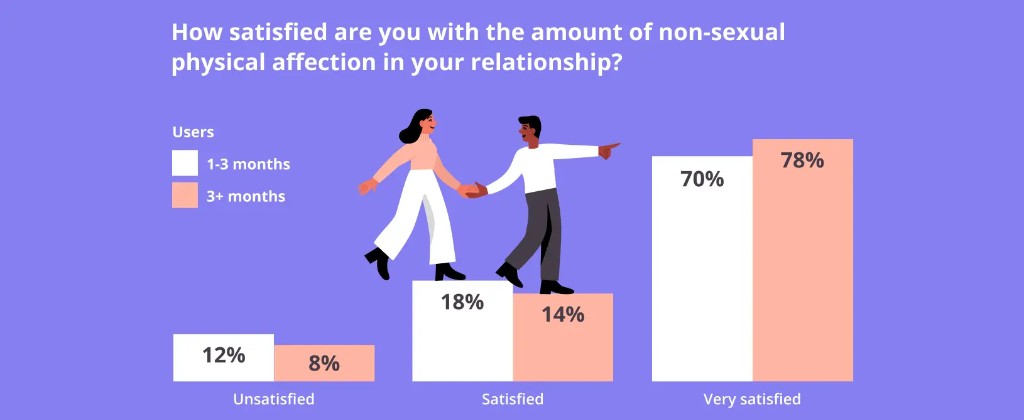
Across the board, cuddling officially came out on top. Around 70% of people say they are satisfied with the amount of non‑sexual touch in their relationships and often crave this kind of affection even more than sex.
The pandemic appears to have shifted how people value physical closeness. Over half of respondents (51%) agreed that their desire for non‑sexual touch has increased since 2020.
Content about cuddling sparked some of the highest engagement in the app, suggesting that couples are hungry not just for information about sex, but for ideas on how to feel physically close in everyday life.
“Non‑sexual touch brings a deeper connection to relationships by non‑verbally communicating acceptance to each other,” says Moraya Seeger DeGeare, licensed marriage and family therapist.
“Having non‑sexual physical touch be a part of your relationship routines — longer hugs, holding hands, snuggling on the couch — you are giving your love a message of ‘I am here, right here holding you’.”
Researcher and sociologist Lisa Slattery Walker, Ph.D., adds that snuggling is a powerful form of nonverbal communication with many elements, sending multiple messages of connection at once.
Her work, including the paper “What Does That Smile Mean? The Meaning of Nonverbal Behaviors in Social Interaction,” suggests that the meaning we attach to a partner’s affectionate gesture is a big part of why it feels so good.
Snuggling takes the top spot
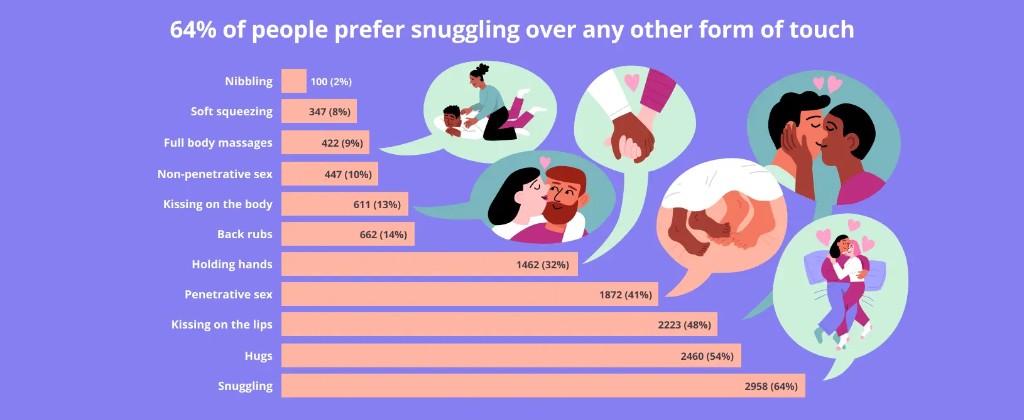
When asked which form of non‑sexual touch makes them feel closest to their partner, 64% of people chose snuggling.
This love of snuggles showed up inside Lova too. The “Classic Game: Snuggleholics” reached a 91% answer rate, and “The Cuddle Pack” became one of the most popular question packs in the app.
Hugging still played an important role, with 54% saying that this kind of affection helps them feel closest to their partner. Meanwhile, 48% of respondents said that a kiss on the lips is what makes them feel most connected.
The game “You or Me? Hugs and Kisses” is Lova’s highest‑answered game ever, with 95% of users engaging, and “The Kissing Pack” has quickly become one of the top‑performing sets of questions since its release.
When partners worry about not giving enough affection
Even with all this love for touch, not every couple feels completely in sync about it.
While 44% of couples believe they share the same desire for physical affection, 26% think their partner wants more touch and affection than they are currently offering.
About 17% of people report being unhappy with the amount of non‑sexual touch in their relationship, and 22% say they rarely talk about their physical touch needs at all.
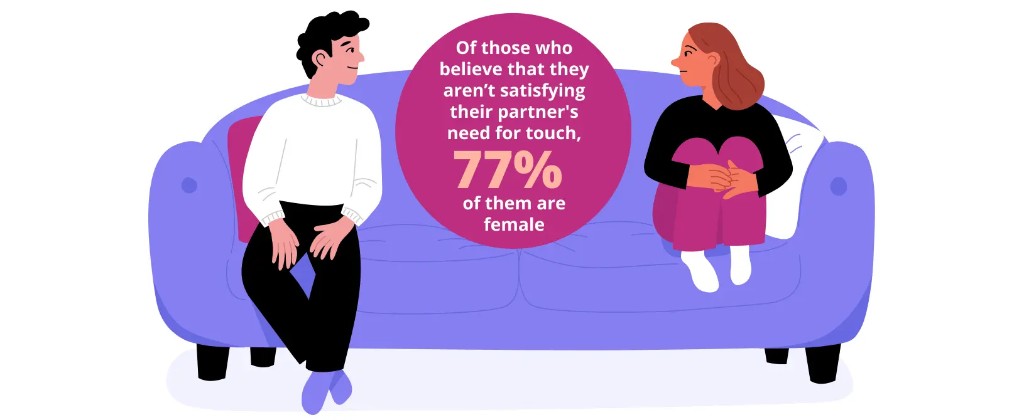
Women, in particular, seem to avoid these conversations. Among those who never talk about touch, 59% are women, and 77% of those who believe they are not satisfying their partner’s need for affection are also female.
“Often you have one partner who desires sex more,” explains Seeger DeGeare. “Just bringing up a craving for more physical intimacy can give off a green light to the other partner, who is eagerly on the lookout for signs their lover is in the mood.”
On the flip side, a partner who is not interested in more physical intimacy may avoid the topic entirely to dodge conflict, which can leave both partners stuck in a cycle of confusion and frustration.
One benefit of an app like Lova is that it gives couples a playful, low‑pressure way to start these conversations. After three months of using Lova, the share of people unhappy with touch in their relationship dropped from 12% to 8%, and 88% agreed that the app helped them talk about touch and physical affection.
So, what about sex?
Non‑sexual touch might be trending, but that does not mean sex has disappeared from the picture.
In Lova’s survey, 61% of people said they are very satisfied with their sex lives. Even though snuggling ranked higher overall, 41% felt that sexual intimacy makes them feel closer and more connected to their partner.
Among the 17% who described themselves as unhappy with their sex life, that number decreased to 13% after more than three months of using Lova.
Between playful questions, sex and intimacy packs, and opportunities to share preferences in a structured way, many couples seem to find that simply opening up the conversation leads to better experiences in bed.
What couples can expect from 2024
So with all this data, what is likely to be “in” and “out” for couples in 2024? Seeger DeGeare has a few predictions.
Netflix & Chill is out, No‑flix & Connection is in. While cozying up for a show can still be fun, it is not the only kind of intimacy worth prioritizing.
“I love a relaxing time next to my partner, where we do not feel like we have to be on all the time,” she says. “But the thing about Netflix and chill is it is not just that you are not talking — you do not have the opportunity to share more of yourself, and you miss out on moments of deeper understanding.”
Instead, she encourages couples to experiment with evenings that put connection first: tech‑free time, deeper conversations, shared games, or using tools like Lova to spark new ideas for emotional and physical intimacy.
Avoidance is out, authenticity is in
Lova’s data shows that while people are all for affection, they do not always feel comfortable talking about it.
Avoidance is common — especially when someone is worried that being honest might upset their partner or lead to conflict — but it also keeps couples from getting what they truly need.
“It is not just happy wife, happy life — it is healthy partner, healthy connection, healthy you,” says Seeger DeGeare.
She notes that relationship health affects nearly every part of life: lower anxiety and depression symptoms, healthier blood pressure, increased empathy, and better connections with people beyond just your partner.
The key to unlocking those benefits is not a perfect script; it is the willingness to talk openly about what you want and how you feel.
Snuggling stays in — alongside self‑care
If you are a self‑described snuggleholic, do not worry — no one is asking you to give up your favorite kind of touch.
Research shows that hugging and snuggling release a cocktail of feel‑good hormones, including dopamine, serotonin, and oxytocin — sometimes nicknamed the “love hormone” because of its role in bonding.
Snuggling, then, is not just cute; it is biologically powerful.
Looking ahead, Seeger DeGeare predicts that 2024 will be the “Year of Self‑Acceptance,” where couples see intimacy not only as something they share with each other but as something rooted in how kindly they treat themselves.
That might mean combining your snuggle sessions with more intentional self‑care and self‑reflection — checking in with how you feel, what you need, and how you want to grow, both as individuals and as partners.
When both people are taking care of themselves, the relationship often follows: more emotional bandwidth, more patience, and more room for the kind of touch — sexual and non‑sexual — that feels genuinely good for both of you.